

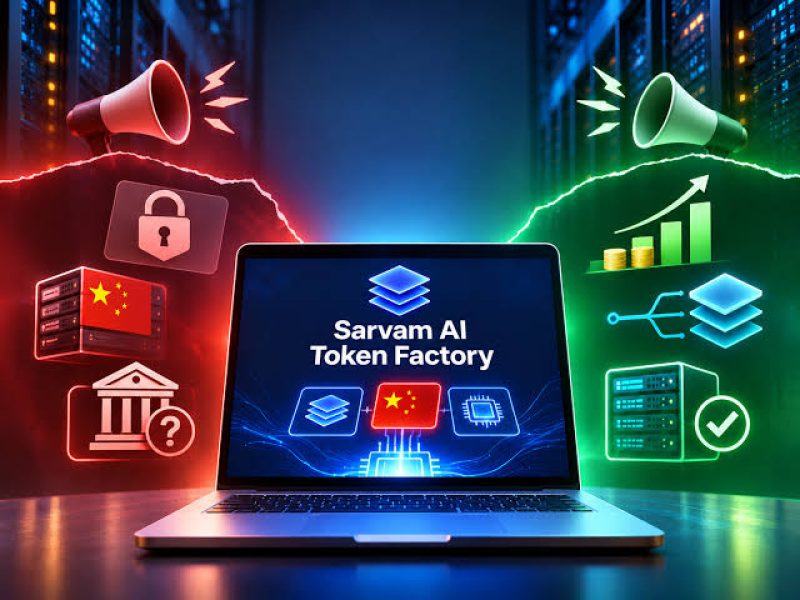
Sarvam AI, one of India’s most visible sovereign AI builders, is now selling access to Chinese AI models. The launch of Token Factory has put a fresh spotlight on a tricky question: can an AI platform be “sovereign” if it runs foreign models?
What Token Factory Is
Token Factory is an inference platform that lets developers and enterprises call multiple AI models through a single, OpenAI-compatible API. The models run on GPU infrastructure in India, operated by Sarvam. It was announced on November 16 and offers shared capacity for changing workloads, plus dedicated capacity and on-premises deployment for heavier users.
What’s in the Catalogue
Sarvam’s own Sarvam 105B sits alongside open-weight models from several labs. Reports list DeepSeek V4.1 Flash, Moonshot’s Kimi, Z.ai’s GLM and Alibaba’s Qwen, plus Google’s Gemma. Reports differ slightly on the exact list, so check Sarvam’s product page.
Pricing and Performance
At launch, Sarvam listed introductory rates for the DeepSeek V4.1 Flash endpoint at ₹14 per million input tokens and ₹55 per million output tokens. The company’s own tests show Gemma 4 31B returning its first token in a median of 0.40 seconds from a Mumbai client. These are company-published figures, not independent benchmarks.
The Backlash
Bloomberg reported that the launch triggered an online backlash because Sarvam has been among the main proponents of India’s AI independence. Critics ask whether hosting Chinese models in sensitive sectors such as banking, government or telecom fits the sovereign AI promise.
Sarvam’s Response
Co-founder Pratyush Kumar said the company remains committed to building Indian-made AI. He said Token Factory runs on GPUs Sarvam bought itself, and that subsidised compute privileges ended in March 2026. Co-founder Vivek Raghavan said the infrastructure is privately funded to keep data secure and cover heavy running costs.
What the Evidence Shows
One industry analysis notes there is no verified evidence that Sarvam sends customer data to China or that the hosted models contain backdoors. Hosting open-weight models locally also echoes India’s earlier stance: in 2025, IT Minister Ashwini Vaishnaw said privacy concerns about DeepSeek could be addressed by running open models on Indian servers.